


The dispute centers on a recent integration with CoW Swap that changed how revenue is distributed.
The Revenue Diversion Discovered
On December 11, 2025, a pseudonymous Aave DAO delegate named EzR3aL posted an open letter in the Aave governance forum questioning where swap fees were going. Through on-chain analysis, EzR3aL traced fees to a private address controlled by Aave Labs rather than the DAO treasury.
The financial impact is significant. According to the analysis, the fee diversion amounts to approximately $200,000 per week, or roughly $10 million annually. This represents about 10% of the Aave DAO’s potential revenue, which community members argue belongs to token holders.
Previously, Aave used ParaSwap for swap functionality. That arrangement sent surplus revenue to the DAO treasury without charging users explicit fees. The last weekly transfer was valued at 46 ETH ($3,050.42), worth over $150,000 at the time.
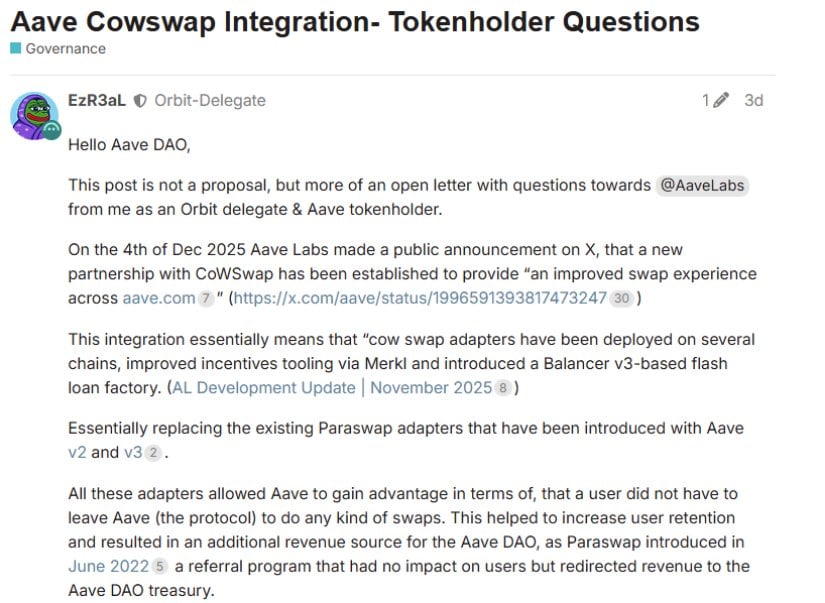
Source: governance.aave.com
The new CoW Swap integration, which began rolling out in mid-2025 and was fully announced on December 4, 2025, charges users fees of 15-25 basis points on swaps. However, these fees now flow to Aave Labs instead of the community treasury.
Key Players Take Sides
Marc Zeller, founder of the Aave Chan Initiative, called the situation “extremely concerning” and described it as “stealth privatization” of approximately 10% of the DAO’s potential revenue. Zeller argued that Aave Labs leveraged brand assets and intellectual property paid for by the DAO.
“Aave Labs, in the pursuit of their own monetization, redirected Aave user volume towards competition. This is unacceptable,” Zeller wrote in the governance forum. He noted that engineers from the Aave Chan Initiative had contributed extensively to the Aave Labs-maintained interface under the assumption that monetization would benefit the DAO.
Zeller also raised broader concerns about upcoming features. He questioned whether other elements like Aave Vaults, Horizon, and the V4 liquidation engine might also be “ring-fenced” from the DAO, potentially cutting revenues by tens of millions per year.
Aave Labs Defends Its Position
Stani Kulechov, founder and CEO of Aave Labs, responded publicly on social media and in the governance forum. He rejected the characterization of the situation as stolen revenue, arguing that previous ParaSwap fees were a “discretionary surplus” that Aave Labs voluntarily donated to the DAO.
“It was never a fee switch, its been a surplus that we donated to the DAO,” Kulechov stated. He drew a sharp distinction between the Aave protocol itself, which is governed by the DAO through smart contracts, and the frontend interface at Aave.com, which he described as a private product funded and maintained by Aave Labs.
Kulechov emphasized that Aave Labs bears the costs of engineering and security for the website, and the DAO does not subsidize ongoing product development expenses. He maintained that it’s appropriate for Aave Labs to monetize its products, especially features that don’t touch the protocol itself.
“It’s also perfectly fine for Aave Labs to monetize its products, especially as they don’t touch the protocol itself,” he said.
Aave Labs acknowledged a failure to communicate the change effectively but defended the technical decision. The company said it switched to CoW Swap to deliver better execution prices and stronger protection against MEV (maximum extractable value), not primarily to generate revenue.
The Scale of Aave’s Operations
The dispute unfolds against the backdrop of Aave’s massive growth. The protocol currently holds over $34 billion in total value locked and generates over $100 million in annualized revenue, making it the dominant player in DeFi lending with approximately 60% market share.
Aave operates across more than a dozen blockchains, though 86.6% of its revenue comes from Ethereum mainnet. The protocol has been preparing for its V4 upgrade, which promises architectural improvements and better capital efficiency.
Broader Governance Questions
This conflict highlights fundamental tensions in decentralized autonomous organization governance. The core questions include who owns revenue from integrations built with DAO resources, whether service providers funded by the DAO have fiduciary duties to token holders, and where the line exists between DAO-governed protocols and company-controlled products.
Community members in the governance forum described the move as an “unforced error” and accused Labs of “mis-alignment.” The discussion generated over 30 comments within hours, with some participants calling for “re-unification” between the two entities.
Zeller also pointed out that the CoW Swap integration resulted in two lost revenue streams for the DAO. Besides losing ParaSwap referral income, the DAO also lost flash loan fees because CoW Swap solvers frequently use Balancer’s fee-free flash loans instead of Aave’s paid flash loans.
What Happens Next
The Aave Chan Initiative has promised to prepare an official response to the situation. As of December 14, 2025, no formal governance proposal has been submitted to address the fee routing, and the dispute remains unresolved.
The situation could lead to proposals redirecting fees back to the DAO treasury or establishing clearer policies for future integrations. Token holders may ultimately vote on how to handle revenue from frontend features versus core protocol functionality.
For now, the Aave community continues debating the proper relationship between a decentralized protocol and the centralized development company that builds its primary interface. The outcome could set important precedents for how other DeFi protocols handle similar governance challenges.
The Path Forward
This dispute serves as a critical test case for DeFi governance. As protocols mature and generate substantial revenue, questions about who controls that revenue and how decisions get made will only become more important. The Aave community must now decide whether service providers can unilaterally monetize features built on DAO-funded infrastructure or whether such decisions require explicit community approval.
The resolution of this conflict will likely influence not just Aave’s future but also how other major DeFi protocols structure relationships between their DAOs and development companies.







 24h Most Popular


 Utilities