


The move comes as close ally Russia signals plans to ease its restrictive cryptocurrency regulations, creating a complex regional policy landscape amid ongoing Western sanctions.
Key Exchanges Cut Off
The Belarusian Ministry of Information added Bybit, OKX, Bitget, BingX, Gate, and Weex to the national restricted access list on December 9, 2025, following a notification from the Minsk City Executive Committee. The government cited “inappropriate advertising” under Article 51.1 of the Law on Mass Media, though detailed violation information is only provided to the platforms’ owners.
The blocks affect some of the world’s largest crypto trading platforms. Notably absent from the restricted list are Binance and KuCoin, despite their popularity among Belarusian traders. According to Article 51.2 of the Law on Mass Media, platform owners can apply for access restoration after eliminating the violations that prompted the restrictions.
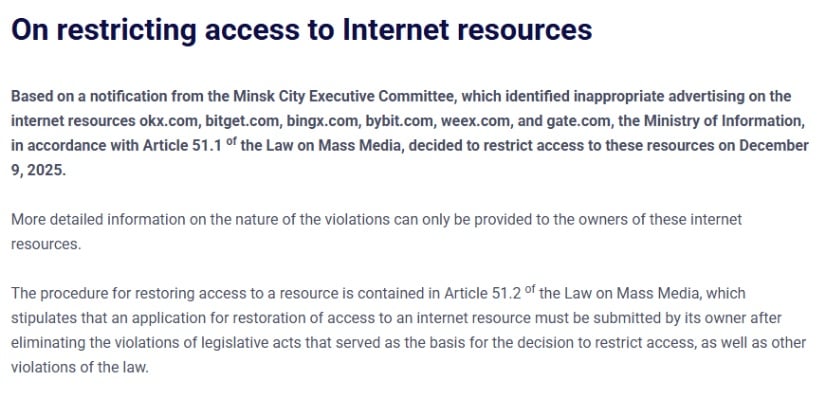
Source: mininform.gov.by
Users of Beltelecom, the state-owned internet provider, first reported being unable to access Bybit’s trading platform on December 9. Some traders have bypassed the restrictions using VPNs, but this could violate exchange terms of service and lead to account suspensions.
Regulatory Framework Behind the Blocks
The exchange blocks stem from Belarus’s complex cryptocurrency regulatory system centered around the High-Tech Park (HTP). Under a September 2024 decree, all individual cryptocurrency transactions must occur through HTP resident companies.
None of the blocked exchanges have HTP resident status, meaning their use for local peer-to-peer trades was already outside legal boundaries. Legal experts suggest the blocks may relate to compliance gaps or unauthorized P2P activity that bypassed the HTP requirements.
The HTP offers significant incentives to crypto businesses. Companies operating within the special economic zone enjoy tax rates of just 9% on crypto transaction profits in 2025, while non-residents face rates of 20-25%. These preferential conditions extend until 2049, making Belarus an attractive destination for blockchain companies.
Russia Takes Different Approach
The timing of Belarus’s restrictions coincides with Russia signaling a more open stance toward cryptocurrency access. Around the same time Belarus blocked the exchanges, Vladimir Chistyukhin, first deputy chairman of Russia’s Central Bank, announced the country had “agreed to allow qualified investors” into the crypto market.
Russia currently limits cryptocurrency transactions to “super-qualified investors” – individuals with over 100 million rubles in assets or annual income exceeding 50 million rubles. Chistyukhin explicitly linked discussions to ease these requirements to Western sanctions, noting restrictions “on the use of normal currencies for making payments abroad.”
The diverging approaches highlight different regional strategies. While Belarus is tightening control and restricting access to foreign platforms, Russia appears focused on building controlled domestic channels rather than implementing blanket bans. Russian companies have already begun using Bitcoin for international payments under an experimental legal framework introduced in 2024.
EU Sanctions Pressure Intensifies
The exchange blocks occur against a backdrop of escalating European Union sanctions targeting cryptocurrency activities. The EU’s 19th sanctions package, adopted on October 23, 2025, specifically targeted crypto-related payment services and included five new listings related to the Belarusian military-industrial complex.
For the first time, EU sanctions prohibited the use of specific cryptocurrencies, targeting the Russian rouble-backed stablecoin A7A5 and related trading platforms. The measures aim to close loopholes and prevent sanctions evasion through digital assets.
The pressure has pushed both countries toward developing alternative financial systems. Russia has developed the A7A5 stablecoin system, enabling businesses to convert rubles into USDT ($1.00) for international payments despite traditional banking restrictions.
Regional Policy Split Emerges
The contrasting approaches between Belarus and Russia reflect broader tensions about cryptocurrency’s role in circumventing Western financial restrictions. Belarus President Lukashenko has demanded clearer regulations after government inspectors found major violations at cryptocurrency platforms, with half of all money sent abroad by Belarusian investors never returning.
Experts suggest Russia is unlikely to follow Belarus’s restrictive path. Moscow views cryptocurrency as “indispensable” for maintaining trade relationships under sanctions. The Russian government has been testing national crypto exchanges and cross-border settlement systems as alternatives to traditional banking channels.
The National Bank of Belarus has proposed creating a unified crypto regulatory framework within the Eurasian Economic Union (EAEU), with Russia preparing comprehensive crypto rules for 2026. However, the recent policy divergence suggests coordination challenges ahead.
Market Impact and User Concerns
The sudden blocks have disrupted trading strategies and portfolio management for affected users. Market observers note that unilateral access restrictions can damage user confidence in both domestic regulation and international platforms. While the government cited “inappropriate advertising,” the lack of detailed public explanation has created uncertainty about the duration and scope of the restrictions.
Some analysts suggest the restrictions could push more users toward decentralized platforms or cross-border solutions, potentially fragmenting the regional crypto market. The combination of internet-layer blocks and opaque decision-making may intensify scrutiny of centralized exchanges operating in Eastern Europe.
The moves have also raised concerns about regulatory uncertainty for crypto businesses with exposure to Belarus, despite the government’s previous efforts to position the country as a digital haven for blockchain companies.
The Crossroads of Control and Innovation
Belarus and Russia find themselves at a critical juncture, balancing domestic financial control with the practical necessity of alternative payment systems under sanctions. While Belarus chooses restriction to maintain tight oversight, Russia pursues adaptation to preserve trade capabilities. This policy split reveals the complex challenges facing sanctioned nations as they navigate the intersection of geopolitical pressure and financial innovation. The ultimate success of either approach will likely influence broader regional cryptocurrency policy for years to come.











 24h Most Popular


 Utilities