


The feature went live in December 2025, marking one of the most significant adoptions of cryptocurrency payments by a major social media platform.
The integration lets eligible creators choose PYUSD instead of traditional bank transfers for their ad revenue, memberships, and Super Chat income. According to May Zabaneh, PayPal’s head of crypto, the system allows YouTube to offer crypto payouts without directly handling digital assets.
How the System Works
YouTube continues sending creator earnings to PayPal in regular U.S. dollars. PayPal then handles all the cryptocurrency conversion on the backend, transforming those payments into PYUSD for creators who select this option.
“The beauty of what we’ve built is that YouTube doesn’t have to touch crypto and so we can help take away that complexity,” Zabaneh told Fortune in an exclusive interview.
The setup required zero changes to YouTube’s platform. PayPal added PYUSD payout capabilities to its payment infrastructure in the third quarter of 2025. YouTube, which already used PayPal’s enterprise payout system for creators and contractors, simply enabled the option that PayPal had made available.
A Google spokesperson confirmed the feature is now live but declined to provide additional details about adoption rates or international expansion plans.
Understanding PYUSD
PayPal USD, known as PYUSD, is a stablecoin designed to maintain a constant 1-to-1 value with the U.S. dollar. Unlike volatile cryptocurrencies like Bitcoin or Ethereum, PYUSD aims to provide the speed and flexibility of digital currency without price swings.
The stablecoin is issued by Paxos Trust Company and regulated by the New York State Department of Financial Services. Every PYUSD token is backed by actual U.S. dollar deposits, Treasury bonds, and cash equivalents held in reserve. Paxos publishes monthly reports showing exactly what assets back the stablecoin.
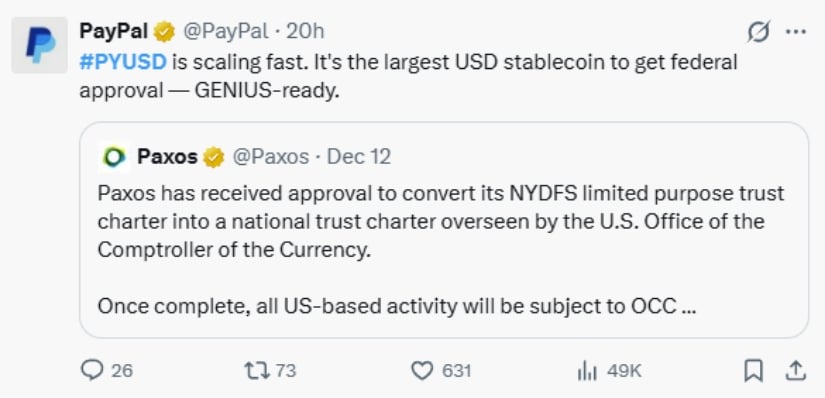
Source: @PayPal
Since launching in August 2023, PYUSD has grown significantly. The stablecoin’s market value reached approximately $3.9 billion in December 2025, up from around $1.2 billion just three months earlier. This 224% growth in circulation has made PYUSD the sixth-largest stablecoin globally.
The token operates on multiple blockchain networks, with the largest amounts circulating on Ethereum ($2.79 billion) and Solana ($1.046 billion).
Creator Benefits and Limitations
The new payout option offers several advantages for content creators. Traditional bank transfers often take several days to complete, while PYUSD payments settle almost instantly. International creators dealing with cross-border payments may also benefit from reduced fees and faster processing times.
Once creators receive PYUSD, they have multiple options. They can keep the stablecoin in their PayPal or Venmo wallets, convert it back to regular dollars, spend it at merchants that accept PYUSD, or move it to external cryptocurrency wallets for other uses.
However, the feature currently has significant restrictions. Only U.S.-based creators can access PYUSD payouts. Creators must already use PayPal for their YouTube earnings to qualify. YouTube has not announced when or if the option will expand to creators in other countries.
The choice is completely voluntary. Creators who prefer traditional bank transfers can continue using them without any changes to their payment setup.
Regulatory Framework and Timing
The YouTube integration arrives after major regulatory developments in U.S. cryptocurrency policy. In July 2025, President Donald Trump signed the GENIUS Act into law, establishing the first federal framework for stablecoins in the United States.
The legislation requires stablecoin issuers to maintain 100% reserve backing with liquid assets like U.S. dollars or short-term Treasury bills. Issuers must publish monthly reserve reports and follow strict anti-money laundering rules. The law also prevents companies from making misleading claims that stablecoins are government-backed or federally insured.
This regulatory clarity has encouraged major technology companies to explore stablecoin integration. Google Cloud previously accepted PYUSD payments from two customers before YouTube’s broader creator rollout.
Broader Stablecoin Adoption
YouTube’s move reflects growing mainstream acceptance of stablecoins for practical payments rather than just cryptocurrency trading. PayPal has been aggressively expanding PYUSD’s reach across its product ecosystem.
In July 2025, PayPal launched a merchant payment system allowing U.S. businesses to accept over 100 different cryptocurrencies, including PYUSD. In September, the company added peer-to-peer crypto transfers through its “PayPal Links” feature, enabling users to send Bitcoin, Ethereum, and PYUSD directly to friends and family.
Other major platforms are watching closely. Industry reports suggest companies like Apple, Airbnb, and X (formerly Twitter) are exploring stablecoins for their payout systems. Payment processor Stripe acquired stablecoin startup Bridge for $1.1 billion in February 2025, signaling strong institutional interest.
State Street and Galaxy Asset Management plan to launch a tokenized liquidity fund in early 2026 that will use PYUSD as its settlement currency, demonstrating that traditional financial institutions see value in the technology.
The Path Forward
For YouTube creators, the PYUSD option adds flexibility to how they receive and manage their earnings. The system’s reliance on PayPal’s infrastructure means creators don’t need to understand cryptocurrency technology to use it.
However, several questions remain unanswered. YouTube has not shared how many creators have adopted the feature or what percentage of payouts now go through PYUSD. The company also hasn’t indicated whether international expansion is planned.
For now, the feature represents a careful first step into cryptocurrency payments for one of the world’s largest video platforms. By letting PayPal handle all the technical complexity, YouTube can offer crypto options while avoiding the regulatory and operational challenges of managing digital assets directly.
The integration shows how stablecoins are moving from speculative trading instruments to practical payment infrastructure. Whether this marks the beginning of widespread crypto adoption in the creator economy or remains a niche option will depend on how many creators actually choose to receive payments in PYUSD instead of traditional currency.
Digital Dollars, Real Adoption
YouTube’s PYUSD integration demonstrates that cryptocurrency can enter mainstream platforms without requiring those platforms to become crypto companies. By routing through PayPal’s regulated infrastructure, YouTube offers creators a new payment option while maintaining the simplicity and familiarity of its existing systems. As regulatory frameworks solidify and more companies explore similar approaches, stablecoins may gradually become a standard choice alongside traditional payment methods rather than a replacement for them.







.jpg)

 24h Most Popular

 Utilities